I'm tired of the strawberry argument
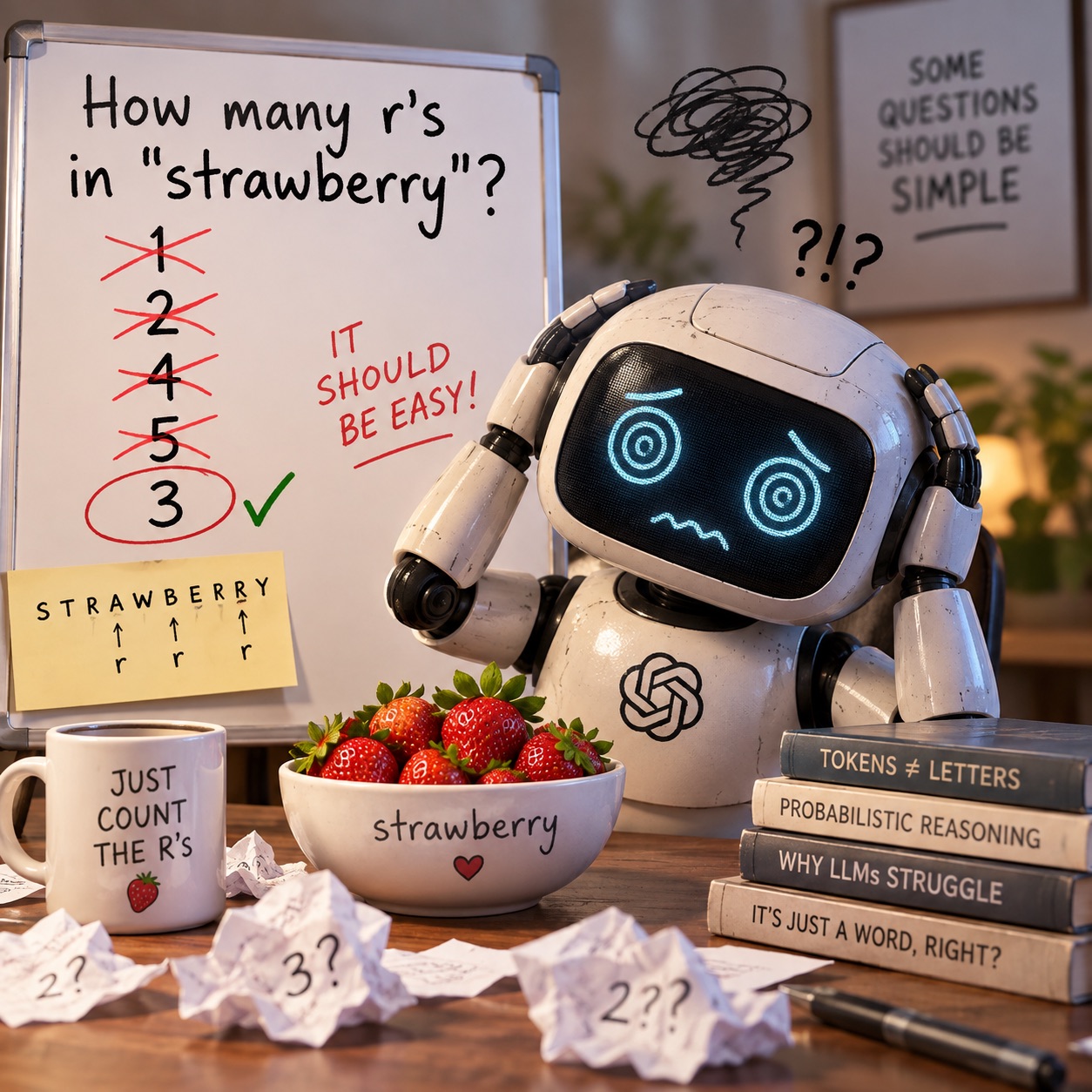
There are three r’s in strawberry.
There. We can all go home.
Except apparently we can’t, because this particular piece of fruit keeps being asked to settle the entire argument about artificial intelligence. A language model gets the count wrong, someone posts the screenshot, and we’re off again. It can’t count to three, so how could anyone trust it to write code? Then comes the defence: it uses tokens, so the question doesn’t count.
I’m tired of both responses. The failure deserves an explanation. The explanation also needs to take the failure seriously. And I’d quite like us to get past the screenshot.
First, count the actual letters
The word has ten letters. Number them:
Position:  1  2  3  4  5  6  7  8  9 10
Letter:    s  t  r  a  w  b  e  r  r  y
The r’s are at positions 3, 8 and 9. A conventional program can settle this with:
"strawberry".count("r") # 3When Python executes that expression, it performs a defined string operation. A language model answering in prose doesn’t automatically execute the equivalent operation just because the question calls for one. That’s where the interesting part starts.
Also, let’s retire “LLMs consistently fail at this.” Which model? Which prompt? With tools enabled? A wrong answer demonstrates a failure in that setting. It doesn’t establish that every model always fails, any more than one correct answer establishes that the problem is solved.
Tokens explain some of the difficulty
Most language models process text as tokens: chunks that can represent whole words, parts of words, or smaller units. They don’t normally receive one independently represented input item for each letter.
A schematic split might look like this:
["straw", "berry"]That is an illustration, not a claim about a particular tokenizer. The actual split depends on the tokenizer and the surrounding text. The point is that the model’s input units needn’t line up with the units you’ve asked it to count.
The model must work with information about the characters inside those units. Counting letters isn’t simply counting the input items.
But “it uses tokens” is where too many explanations stop. Tokenisation doesn’t make spelling information disappear. A model can learn about the internal structure of tokens, and being able to spell a word doesn’t ensure it will reliably count a particular letter in that word.
A study of eight models across 10,000 words found that the models could identify letters while still struggling to count their occurrences. Errors were associated particularly strongly with how many letters appeared more than once. Word and token frequency didn’t explain the errors in that study.
That’s a more useful finding than “the model can’t see letters.” It points to a difficulty in using the information reliably, even when the information is available.
Knowing the spelling doesn’t guarantee the count
A model can produce s-t-r-a-w-b-e-r-r-y correctly and still give the wrong
number of r’s. Those are different tasks, however similar they look to us.
Language-model pretraining centres on predicting the next token. That can support learning spelling, relationships, procedures and much else. It doesn’t turn every answer about a string into an exact string operation.
Nor does it mean a model is incapable of learning to compute. “It’s just predicting the next token” tells you about the training objective; it doesn’t settle everything the resulting system can do. We shouldn’t use that phrase as a substitute for investigating the behaviour either.
In strawberry, there is an r near the beginning and a pair near the end. All three occurrences must contribute to the total. Repeated letters are a documented source of difficulty in the study above, but claiming the model “mentally collapses the pair” would be a story about its internals, not something the wrong answer alone proves.
We can explain the limitation without pretending we watched the model think “probably two.”
Yes, changing the prompt can help
Ask a model to list the characters and identify the matching positions before giving the count, and it may do better. Now it has an explicit intermediate sequence to work with, like the numbered example above.
This isn’t merely a convenient excuse invented after a bad answer. Research on word-based counting tasks found substantial improvements from reasoning strategies compared with requesting a direct numeric answer. It also challenged the idea that tokenisation alone makes these failures inevitable.
That matters. How you ask can change what the model successfully does.
It still doesn’t make a written explanation a correctness guarantee. The model can generate a faulty intermediate step or produce a total that doesn’t match its own list. A readable working-out is something we can inspect. It isn’t proof that an exact counting routine ran.
And testing “strawberry” over and over is a fairly narrow way to measure progress. To assess the capability, vary the words, the number and placement of repeated letters, and the prompt. Record the model and whether it used tools. A familiar answer by itself tells us very little about general reliability.
Please let the computer do the counting
If I’m building a system that needs an exact character count, I’ll use a string function. If a language model is part of that system, it can request the operation and use the result.
The distinction is execution. Printing a Python expression and predicting its output still leaves the answer with the model. Running the expression on the actual input gives the answer a checkable basis.
That is ordinary engineering. We already choose different components for parsing, storage, arithmetic and presentation. Adding a language model creates another component whose capabilities and limitations we need to understand.
I made a related argument in my post about AI-assisted coding: the design and the review still belong to the engineer. Here, the design decision is almost comically small. We have a counting function. Use it.
There’s a worthwhile criticism here
A system that delivers an incorrect answer with fluent confidence has a reliability problem. People are right to care about that. If a product invites users to rely on its answers, its builders need to address how it checks exact results and communicates uncertainty. Explaining tokenisation doesn’t discharge that responsibility.
But taking one failure and declaring the entire technology useless doesn’t help us decide where it works, where it fails, or what needs verification. Neither does waving the failure away because the architecture is clever.
The useful questions are concrete. How often does the task fail? Under what conditions? Can we detect the error? Can a small, dependable piece of code handle the part that requires exactness?
I’m happy to have that conversation. I’m fed up with having the screenshot conversation in its place.
Three r’s. Now, please, can we get on with the engineering?