WordPress isn't finished. The way most people buy it is.
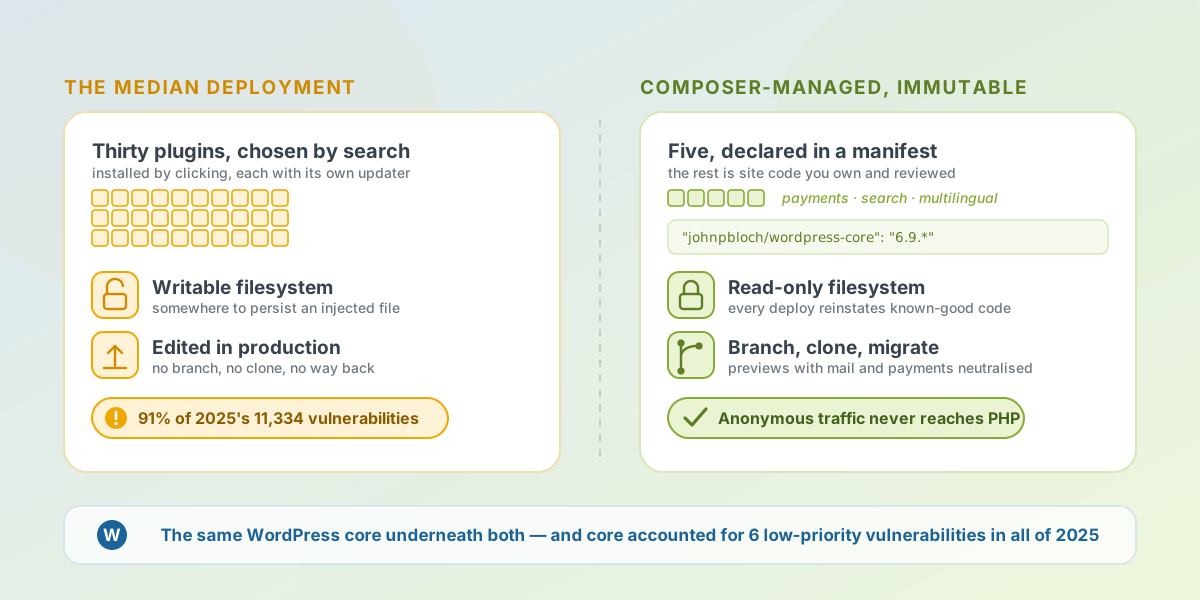
A post crossed my feed recently making an argument I keep hearing in different accents: that selling WordPress sites in 2026 is deontologically reprehensible. Terrible for GEO. A slurry of plugins, glue code and database calls. Its moment of glory over. The recommendation that followed was Shopify for e-commerce and a purpose-built, AI-friendly CMS for everything else.
The post has since been deleted, so I’m paraphrasing rather than quoting, and I won’t name the author. The argument is worth engaging with anyway, because it’s the most articulate version of a criticism that is mostly right about the evidence and wrong about the conclusion.
Disclosure, twice over: I work at Upsun, and I maintain upsun-wp, an open-source plugin for running WordPress there. I have as much bias as anyone in this conversation. Which is exactly why I want to concede the strong parts before defending anything.
Where the post was right
On Shopify, it was right. For a merchant with a catalogue, a cart and a checkout, and no unusual requirements, Shopify’s argument is genuinely hard to beat: hosted, PCI handled, an app for everything, and no need to employ somebody to keep the lights on. Most of the alternatives sold to that merchant are overshooting, and the overshoot does tend to benefit whoever is implementing it. I’d have written the same paragraph.
And on the state of the average WordPress site, it was right too. I’ve spent enough years inside other people’s installations to know what’s in there.
The security criticism is real — and it indicts the plugin market
This is the part where the numbers are unambiguous, so let’s use them rather than vibes. Patchstack’s State of WordPress Security in 2026 counted 11,334 new vulnerabilities across the WordPress ecosystem during 2025 — a 42% increase year on year, with high-severity issues up 113%. For heavily targeted vulnerabilities, the median time from public disclosure to mass exploitation was five hours.
That sounds like a devastating case against WordPress until you read where the vulnerabilities actually were:
- 91% in plugins
- 9% in themes
- 6 in WordPress core — all of them classified low priority
Six. In a year in which the ecosystem produced over eleven thousand. The report also found that hosting-level defences blocked only 12% of attacks using known exploited vulnerabilities, which quietly demolishes the usual answer to this problem — that a WAF and a security plugin will save you.
So the honest reading of the security data is not “WordPress is insecure.” It’s “the WordPress plugin procurement model is insecure.” The failure mode is a site owner installing thirty freemium plugins, each shipping forty features to upsell three, each carrying an update SDK, telemetry, an admin nag and its own attack surface. The vulnerability count is a direct function of how much third-party code you agreed to run.
That reframing matters, because a procurement problem has a procurement solution.
What actually changes
The starter I maintain isn’t clever. It just refuses the default deployment model at every point where that model is the thing causing the damage.
Composer owns everything. Core, plugins, themes, versions, all declared
in a manifest and installed at build time. Nothing is installed by clicking
around in wp-admin, because nothing can be.
The filesystem is read-only in production. Patchstack’s malware section is largely about persistence — injected files in legitimate code, payloads that survive cleanup. On an immutable build there is nowhere to write a webshell, and every deploy reinstates known-good code from the manifest. Uploads and cache are the only writable mounts, and they’re served with scripts disabled.
Anonymous traffic never reaches PHP. The router cache serves HTML at the edge; Redis absorbs the object cache behind it. Sub-second responses stop being an optimisation project and become the default state, because the database isn’t in the request path for the traffic that makes up the overwhelming majority of a content site’s visits.
Every change is a branch. Preview environments are full production
clones, with outbound mail intercepted, payments forced into test mode,
webhooks paused and noindex applied — which is the specific problem
I wrote the plugin to solve.
Schema changes are ordered migrations that run once per database and abort
the deploy on failure, before traffic ever sees them.
None of that is exotic. It’s the deployment discipline every other part of our industry considers table stakes, applied to a CMS whose culture never required it.
The part that’s genuinely new
Here’s what changed recently enough that the original post can be forgiven for not accounting for it.
The reason people install freemium bloatware was never that they wanted forty features. It was that a custom post type, a form handler, a redirect map or a schema-markup layer used to represent days of billable development, and a plugin represented an afternoon. That maths held for fifteen years and it built the entire plugin economy.
It doesn’t hold any more. Most of those requirements are now 100 to 300 lines of reviewed code produced in an hour or two — no upsells, no telemetry, no dashboard nags, no attack surface you didn’t choose. What used to be thirty plugins becomes four or five you genuinely shouldn’t rebuild — payments, search, multilingual — plus site code that does exactly what your site needs and nothing else.
I’ve written before about why I think AI-assisted development works when an experienced engineer stays in the loop and fails when nobody does, and I won’t relitigate it here. But its effect on this particular problem is direct: the economic argument for plugin soup has collapsed. You can now afford to own your code.
About GEO
The claim that WordPress is inherently terrible for generative-engine optimisation was asserted with reference to a “mass of studies” and no citations, so I went looking for them.
What the research actually says is consistent and, for this argument, inconvenient. The GEO paper (KDD 2024) found that the highest-performing techniques were adding statistics and citing sources, worth up to a 40% visibility improvement. Industry analyses converge on the same set of levers: content structure, semantic markup, structured data, topical depth, freshness, and fast, crawlable pages.
Every one of those is a property of your content, your theme and your
infrastructure. Not one of them is a property of the CMS storing the rows.
A WordPress site with a lean block theme, clean semantic HTML, proper schema
and edge-cached sub-second responses does well on precisely the criteria the
research identifies. A WordPress site running a page builder that emits
fourteen nested divs per paragraph does badly — and so would the same
builder on any other platform.
There is a real criticism buried in there, and it’s about themes and page builders, not about WordPress. The post aimed at the wrong target.
There’s also an irony in the alternative offered. “Manage your CMS through an MCP server” was presented as a generational advantage, and it’s a good feature — but WordPress has had a scriptable REST API and WP-CLI for years, and MCP adapters for it now exist. That gap is closing regardless of what anyone builds.
“Its moment of glory is over”
WordPress runs about 41–42% of all websites and roughly 59% of those using a known CMS — down from around 43% in late 2025, and about eight times the share of the next platform. Shopify, the post’s own recommendation, sits near 5%.
A platform losing a point or two of share a year is declining. It isn’t finished, and describing it as finished tells your client something false. Developer mindshare and installed base are different measurements, and it’s worth being clear about which one you’re citing.
What survives
I’d be doing exactly what I’m criticising if I claimed the stack above answers everything. Three things survive, and two of them are the post’s.
WordPress core’s architecture is what it is. Synchronous PHP, a hook system with real overhead, an admin experience showing its age. Edge caching routes around it for anonymous traffic; it doesn’t rewrite it. Logged-in and cart traffic still executes the queries the critics complain about.
For commodity e-commerce, Shopify wins. Cart and checkout are uncacheable by definition, so this is precisely the workload where the architecture above helps least and where you’re now running payment infrastructure yourself. WooCommerce earns its place when you need deep customisation of checkout or pricing logic, data ownership, complex B2B, or shared code with the content site — not when you need a shop.
Owning your plugins means owning their maintenance. This is the one I’d push back on hardest if someone made my argument to me. AI makes writing in-house code cheap; it does not make reviewing it, testing it across core upgrades or living with it for five years free. The freemium model externalised that cost, badly and at a price — but it did externalise it. Take the code in-house and the obligation comes with it. Preview environments and deploy migrations make that obligation survivable. They don’t make it disappear.
The scorecard
| Criticism | Verdict on a Composer-managed, immutable WordPress |
|---|---|
| Plugin soup and freemium bloat | Removed — the economics that caused it no longer hold |
| Slow, database-heavy pages | Mostly removed — anonymous traffic never touches PHP |
| Insecure and easily compromised | Mostly removed — 91% of vulnerabilities are in plugins you no longer run |
| Update hell, no staging, edits in production | Removed — branches, clones, ordered migrations |
| Terrible for GEO | Not supported — the research points at themes and infrastructure |
| Not AI-manageable | Not supported — WP-CLI, REST, MCP adapters |
| Core architecture | Stands — cached around, not fixed |
| WooCommerce for commodity shops | Stands — Shopify is the better answer |
| Maintenance burden | Transferred, not eliminated |
Roughly six of the nine fall. Two stand outright, and they matter — but they apply to a far narrower slice of projects than the original argument implied.
The mistake wasn’t the criticism. It was treating the median WordPress deployment — shared hosting, thirty plugins, edits over FTP — as though it were the ceiling. Judge any technology by its worst-run installations and none of them survive; there is a version of this post to be written about every platform mentioned in it, Shopify included.
Choosing a CMS on behalf of a client is a professional judgement, and it deserves better than a verdict on the whole category. I left WordPress behind on this very site, for reasons that had nothing to do with WordPress being bad at what it does. It just wasn’t the right tool for what I needed. That’s the level the decision belongs at — per project, on the merits, with the trade-offs named out loud. Not a sweeping ethical charge that mostly describes an industry’s bad habits.